
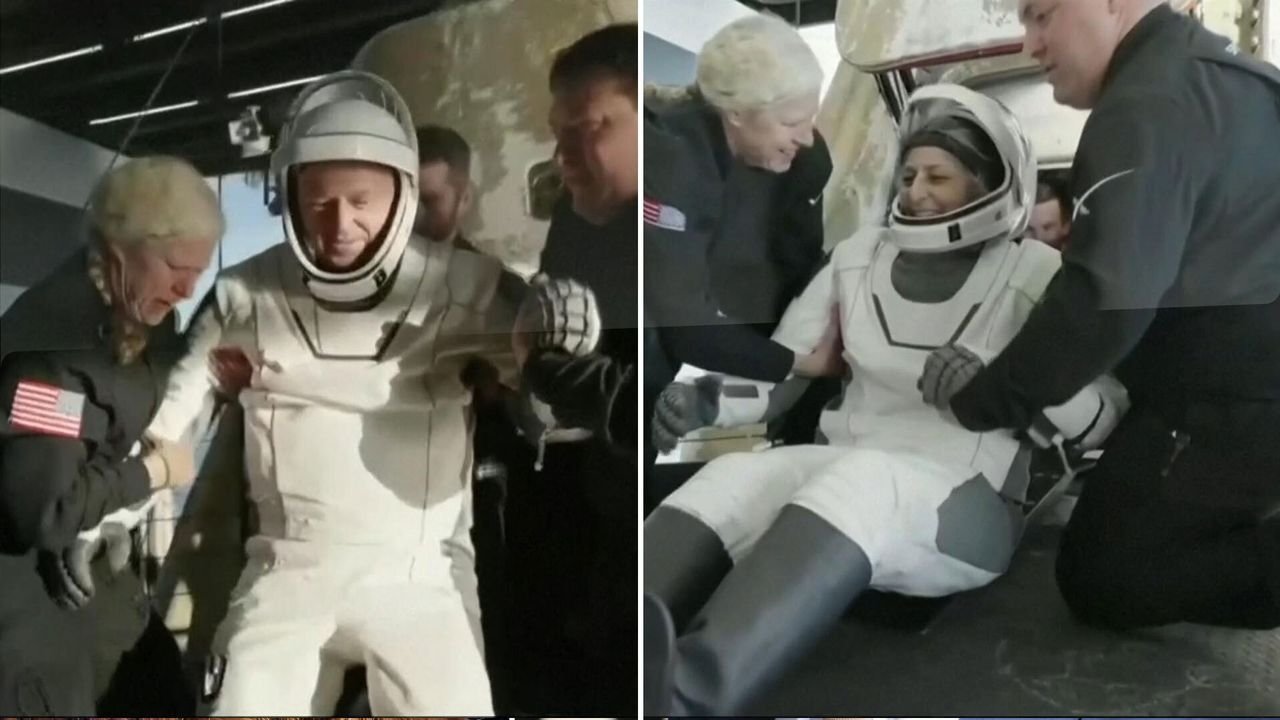
Have you ever wondered what it’s like to return to Earth after spending months floating in space? NASA has developed a special rehabilitation programme to help astronauts recover after long space missions. Established in 2003, this protocol has become essential for the health of these cosmic explorers. Recently, four astronauts returned from the International Space Station (ISS) and are now facing the challenge of readjusting to life on Earth. Let’s take a closer look at how this process works and why it’s so important!
The Mission That Lasted Much Longer Than Planned
On Tuesday (18th), four astronauts landed back on Earth after a mission to the ISS. Two of them, Sunita Williams and Butch Wilmore from NASA, had a journey that lasted far longer than expected. Initially, they were supposed to spend just one week in space, but technical issues with Boeing’s Starliner capsule extended their stay to an incredible 286 days! Meanwhile, Nick Hague, also from NASA, and Aleksandr Gorbunov from Roscosmos (the Russian space agency), completed their mission within the planned six-month timeframe. Regardless of their time in space, all four now need to undergo the same rehabilitation programme.
The Impact of Space on the Human Body
Spending months in microgravity is no easy feat for the human body. Among the most common effects are swelling in the head, muscle weakening, a temporary increase in height, and loss of bone density. To readjust to Earth’s gravity, astronauts follow a 45-day rehabilitation programme established by NASA. This process begins immediately after landing and includes daily two-hour sessions, seven days a week. The training is personalised, taking into account each astronaut’s physical condition, medical exams, and even their preferred recreational activities.
The Three Phases of Rehabilitation
The rehabilitation programme is divided into three phases, each with specific goals:
- Phase 1: Focuses on mobility, flexibility, and muscle strengthening, starting right after landing.
- Phase 2: Includes exercises to improve balance and cardiovascular conditioning.
- Phase 3: The longest stage, dedicated to full functional recovery.
Additionally, astronauts undergo tests for functional fitness, agility, isokinetic strength, and cardiovascular assessment before and after their flight. This data is used to create a personalised exercise plan and evaluate the programme’s effectiveness.
The Starliner Mission Saga
Williams and Wilmore’s mission was marked by a series of unexpected events. Launched on 5th June 2024, the Starliner capsule faced delays due to helium leaks and technical issues. During the journey, more leaks were detected, and docking with the ISS was delayed due to a failure in five of the capsule’s 28 thrusters.
In August, NASA decided that Williams and Wilmore would return to Earth aboard SpaceX’s Dragon spacecraft, alongside the Crew-9 mission members. The Starliner, meanwhile, was sent back empty for safety reasons. Fortunately, all astronauts landed safely in the Gulf of Mexico, where they were greeted by the rescue team and even some friendly dolphins!
Why is Rehabilitation So Important?
Spending months in space can have significant impacts on the human body. The lack of gravity weakens muscles and bones, and the cardiovascular system needs to readjust to Earth’s gravity. NASA’s rehabilitation programme was created precisely to help astronauts recover their health and functionality after these challenging missions.
If you’re fascinated by space exploration, stay tuned for more updates on the adventures and challenges astronauts face in space and back on Earth! 🚀
